
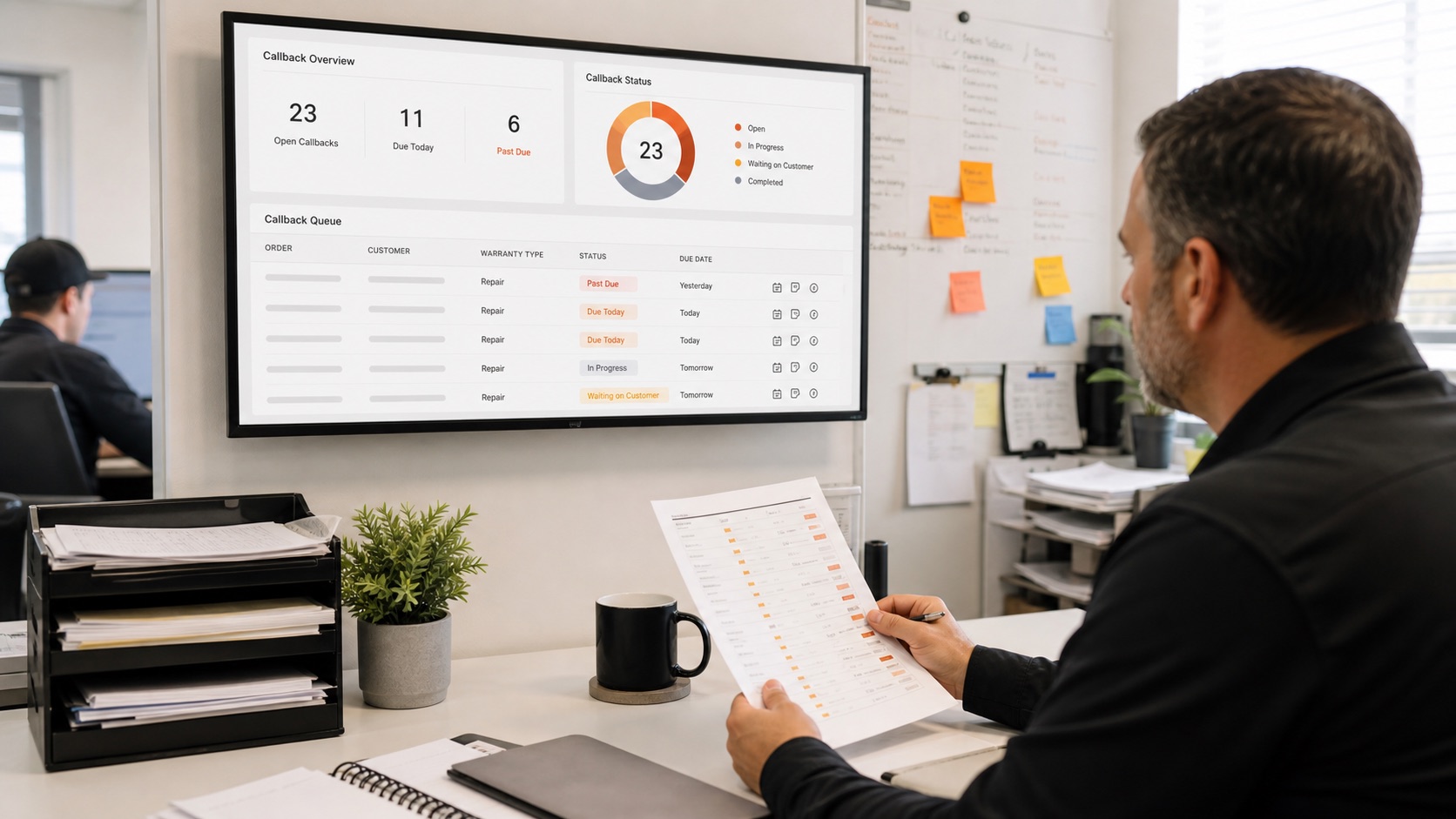
Warranty Callback Tracking for Service Businesses: Turn Repeat Visits Into Better Operations
Build This In Joby
Warranty callbacks are easy to treat as one-off annoyances: a customer calls back, dispatch squeezes in a visit, the technician resolves it, and the team moves on. That approach hides the real cost. Callbacks consume schedule capacity, technician time, customer trust, and sometimes margin that looked healthy when the invoice first closed.
A better callback workflow tracks the reason, owner, customer communication, and final outcome. The goal is not to blame the field team. It is to learn whether the business has a training issue, product issue, estimate-scope issue, material issue, or customer-expectation issue.
Create callback categories the office can use quickly. Start with a small list: workmanship, part failure, diagnosis missed, customer education, access issue, weather-related, manufacturer warranty, or unclear scope. If the list is too detailed, reps will skip it. If it is too vague, reports will not help.
Link the callback to the original job. A repeat visit should not float as a new appointment with no context. Tie it back to the estimate, invoice, technician notes, photos, and customer communication. That lets managers see whether the original job had warning signs before the callback happened.
Assign ownership without turning it into blame. Someone needs to own the customer update and someone needs to own the operational review. Those may not be the same person. A dispatcher can coordinate the appointment while a service manager reviews the root cause after completion.
Protect the schedule from hidden callback load. Warranty work often gets squeezed into an already full board. Track callback appointment time separately so owners can see how much capacity is being spent on non-billable work. That data helps with staffing, training, pricing, and quality decisions.
Standardize the customer update. Customers are usually less upset when they know what happens next. The office should explain whether the visit is covered, what the technician will inspect, when the customer will hear back, and whether any additional approval may be needed.
Close the loop with a resolution reason. A callback report is incomplete if it only says completed. Capture whether the issue was repaired, customer educated, new estimate created, manufacturer claim started, or no defect found. Resolution reasons turn repeat visits into usable management data.
How Joby supports the workflow. Joby helps teams keep jobs, dispatch records, tasks, notes, customer communication, estimates, invoices, and reporting closer to one customer record. That makes callback tracking easier to review without claiming the app automatically diagnoses root cause.
The bottom line. Warranty callback tracking turns repeat visits from invisible margin loss into a process the team can improve. Categorize the reason, link the original job, assign ownership, protect the schedule, and review outcomes every week.

'/%3e%3crect%20x='88'%20y='92'%20width='1424'%20height='716'%20rx='34'%20fill='%231f252c'/%3e%3crect%20x='134'%20y='138'%20width='1326'%20height='624'%20rx='28'%20fill='%23ffffff'%20filter='url(%23shadow)'/%3e%3crect%20x='134'%20y='138'%20width='1326'%20height='82'%20rx='28'%20fill='%232b3138'/%3e%3ccircle%20cx='196'%20cy='179'%20r='11'%20fill='%23ff835c'/%3e%3ccircle%20cx='234'%20cy='179'%20r='11'%20fill='%23ffd0c0'/%3e%3ccircle%20cx='272'%20cy='179'%20r='11'%20fill='%23ffffff'%20opacity='0.5'/%3e%3crect%20x='1110'%20y='169'%20width='250'%20height='20'%20rx='10'%20fill='%23ffffff'%20opacity='0.18'/%3e%3crect%20x='204'%20y='270'%20width='392'%20height='410'%20rx='28'%20fill='%23f8fafc'%20stroke='%23e2e8ee'%20stroke-width='3'/%3e%3cpath%20d='M266%20588%20C330%20520%20360%20550%20418%20474%20C470%20404%20512%20428%20548%20354'%20fill='none'%20stroke='%23ff835c'%20stroke-width='14'%20stroke-linecap='round'/%3e%3cpath%20d='M256%20372%20C330%20342%20394%20340%20448%20294'%20fill='none'%20stroke='%2320262d'%20stroke-width='8'%20stroke-linecap='round'%20opacity='0.7'/%3e%3cpath%20d='M284%20628%20C360%20612%20424%20628%20530%20602'%20fill='none'%20stroke='%2320262d'%20stroke-width='8'%20stroke-linecap='round'%20opacity='0.55'/%3e%3ccircle%20cx='296'%20cy='550'%20r='24'%20fill='%2320262d'/%3e%3ccircle%20cx='424'%20cy='468'%20r='24'%20fill='%23ff835c'/%3e%3ccircle%20cx='522'%20cy='360'%20r='24'%20fill='%2320262d'/%3e%3crect%20x='654'%20y='270'%20width='234'%20height='410'%20rx='26'%20fill='%23ffffff'%20stroke='%23e2e8ee'%20stroke-width='3'/%3e%3crect%20x='694'%20y='326'%20width='154'%20height='72'%20rx='18'%20fill='%23fff0e8'%20stroke='%23ffd1c0'/%3e%3crect%20x='694'%20y='426'%20width='154'%20height='72'%20rx='18'%20fill='%23f8fafc'%20stroke='%23e2e8ee'/%3e%3crect%20x='694'%20y='526'%20width='154'%20height='72'%20rx='18'%20fill='%23fff0e8'%20stroke='%23ffd1c0'/%3e%3crect%20x='948'%20y='270'%20width='426'%20height='410'%20rx='26'%20fill='%23f8fafc'%20stroke='%23e2e8ee'%20stroke-width='3'/%3e%3cg%20fill='%23ffffff'%20stroke='%23dfe5ea'%20stroke-width='3'%3e%3crect%20x='988'%20y='326'%20width='144'%20height='88'%20rx='18'/%3e%3crect%20x='1160'%20y='326'%20width='144'%20height='88'%20rx='18'/%3e%3crect%20x='988'%20y='454'%20width='144'%20height='88'%20rx='18'/%3e%3crect%20x='1160'%20y='454'%20width='144'%20height='88'%20rx='18'/%3e%3crect%20x='988'%20y='582'%20width='316'%20height='52'%20rx='18'/%3e%3c/g%3e%3crect%20x='1018'%20y='358'%20width='84'%20height='18'%20rx='9'%20fill='%23ff835c'/%3e%3crect%20x='1190'%20y='358'%20width='72'%20height='18'%20rx='9'%20fill='%2320262d'/%3e%3crect%20x='1018'%20y='486'%20width='62'%20height='18'%20rx='9'%20fill='%2320262d'/%3e%3crect%20x='1190'%20y='486'%20width='90'%20height='18'%20rx='9'%20fill='%23ff835c'/%3e%3crect%20x='1020'%20y='600'%20width='232'%20height='16'%20rx='8'%20fill='%2320262d'%20opacity='0.75'/%3e%3crect%20x='204'%20y='718'%20width='1170'%20height='16'%20rx='8'%20fill='%2320262d'%20opacity='0.12'/%3e%3c/svg%3e)
