
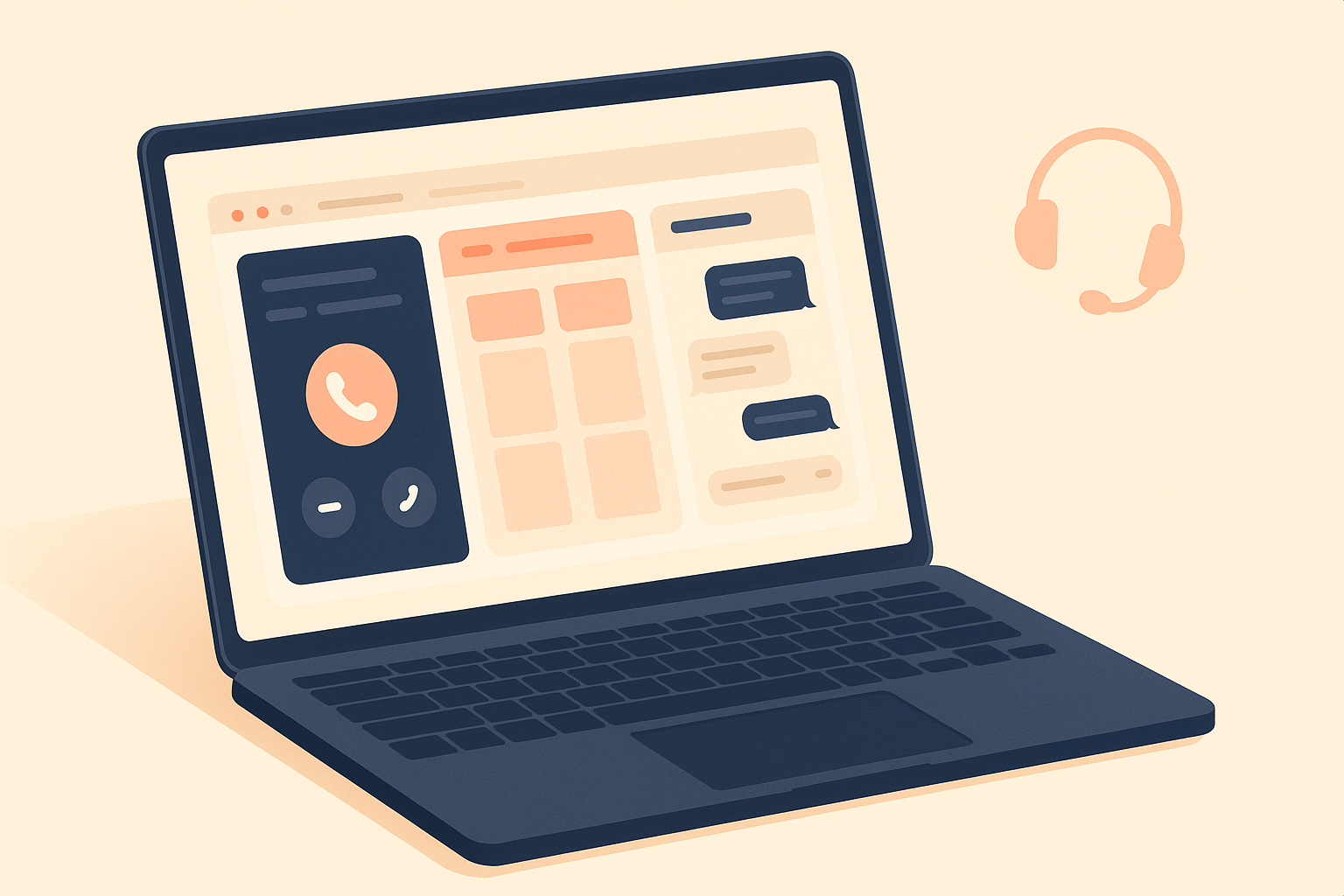
The Complete Guide to a CRM with a Built-In Phone System (2026)
For years, the standard stack for a home-services business looked like this: a CRM for leads, a separate VoIP provider for calls, a third tool for SMS, and maybe a fourth for dispatching. It worked — until it didn't. Every tool needed its own login, its own billing, its own training, and its own integration headaches. A missed call in one system rarely showed up in the other. Office agents lost context the moment they switched tabs.
In 2026, the market is shifting. Teams are replacing multi-tool stacks with a CRM that includes a fully built-in phone system. The promise is simple: one screen, one login, one place where every call, text, lead, estimate, and dispatch lives together. Done well, it's not just more convenient — it's measurably faster, cheaper, and more reliable.
What 'built-in phone system' actually means. A CRM with a real built-in phone system should provision phone numbers for you, let you make and receive calls directly in the browser or mobile app, record those calls, route them through IVR or call groups, and tie every call to a lead record automatically. If the CRM just 'integrates' with Twilio or RingCentral via a button, that's not built-in — that's a bolt-on, and it breaks the moment either vendor changes their API.
Why Twilio-powered matters. Twilio is the underlying carrier infrastructure for most modern cloud phone systems. A CRM that uses Twilio directly through managed sub-accounts gives you enterprise-grade call quality, global reach, SMS compliance, and usage-based pricing you can actually audit — without you having to run a telephony account yourself. Joby runs on Twilio's VoIP and Voice SDK, which means you get the same reliability that powers Uber, Lyft, and Airbnb.
1. Click-to-call from every lead record. The single biggest productivity win is killing the copy-paste-dial workflow. Every phone number in the CRM should be a clickable link. When a lead comes in, your office agent clicks and the call connects in two seconds. Over a 50-call day, that saves an hour.
2. Automatic call logging and recording. Every call should auto-attach to its lead, record (where legal), and transcribe for later search. This is the death of 'I think I talked to them last Tuesday' — and the birth of real call coaching.
3. Visual IVR and call routing. When an unknown number calls, the CRM should route it based on rules you set: area code, time of day, job type, caller history. A visual call-flow builder — drag a box for 'press 1 for sales' — means you change routing without filing a support ticket.
4. Live transcription during the call. Deepgram-powered live transcription turns every call into searchable text in real time. Managers can skim a conversation as it happens. New office agents can get AI-powered suggestions on what to say next. It's one of the most underrated features in a modern phone-enabled CRM.
5. Power dialer for high-volume outbound. When you need to call 100 old leads, you don't want to dial them one by one. A built-in power dialer queues the list, auto-dials the next number when you hang up, and logs outcomes automatically. Most CRMs don't include this — a good Twilio-based one does.
6. Two-way SMS on the same number. Your customers text the number they see on their caller ID. If SMS lives in a different tool than voice, you'll miss half of them. A real built-in phone system handles SMS on the exact same number, with threaded conversations per lead.
7. Mobile app with full softphone. Field teams need the phone system on their phones — not a clunky third-party dialer. Joby's iOS and Android apps include a real Twilio-powered softphone with push notifications, so field workers can answer and return calls from anywhere.
8. AI voice agents (the 2026 unlock). The newest capability: AI voice agents that answer calls after hours, qualify leads, book appointments, and transfer live when needed. This is an add-on for most CRMs — it's native to a handful, including Joby (powered by VAPI + OpenAI voice).
What to avoid. Run from any vendor that says 'phone system' but actually means 'click-to-call via an integration with RingCentral.' Ask: do you provision numbers? do you handle A2P 10DLC registration? do you record and store calls natively? can I build an IVR without writing code? If the answers are anything less than 'yes, native,' keep looking.
The bottom line. For a growing home-services business, consolidating your CRM and phone system into one platform is no longer a 'nice to have.' It's the single highest-ROI change you can make to your tech stack. You'll save money on vendor bills, cut training time, reduce missed leads, and — most importantly — give your office agents one screen to do their job. Joby was built for exactly this outcome.